
Few casino card games reward patience and disciplined decision-making the way poker does. Where many table games leave the outcome entirely to chance, poker gives players a genuine say in how a hand unfolds, which is precisely why it has remained a cornerstone of both physical and online casinos for decades.
At Jackpot City Casino, poker is presented across several formats designed to suit different tastes, from quick RNG-based tables to fully streamed live studio games. This guide breaks the game down for UK players in plain, practical terms, covering everything from the basic rules to bankroll habits worth building before wagering real money.
Newer players sometimes assume poker requires years of experience before it becomes enjoyable, but the casino versions covered here are structured with clear, published rules and defined betting limits, making them approachable even for someone sitting down at a poker table for the first time.
By the end of this guide you’ll have a working understanding of hand rankings, betting actions, RTP expectations and the practical differences between demo and real-money play, along with pointers on where to find the wider game library.
Poker Fundamentals: What the Game Actually Involves
Poker is a card game centred on hand rankings and structured betting rounds. In casino formats, players are typically dealt a set of hole cards, and depending on the variant, community cards may also be revealed to be shared across the table. The goal is to end up with the strongest ranked hand at showdown, or to have every other player fold before that point is reached.
Casino poker games are most commonly offered as player-versus-dealer formats rather than the multiplayer style associated with poker tournaments. This means the player’s hand is measured directly against the dealer’s, with the house applying a defined edge built into the rules rather than needing a full table of paying opponents.
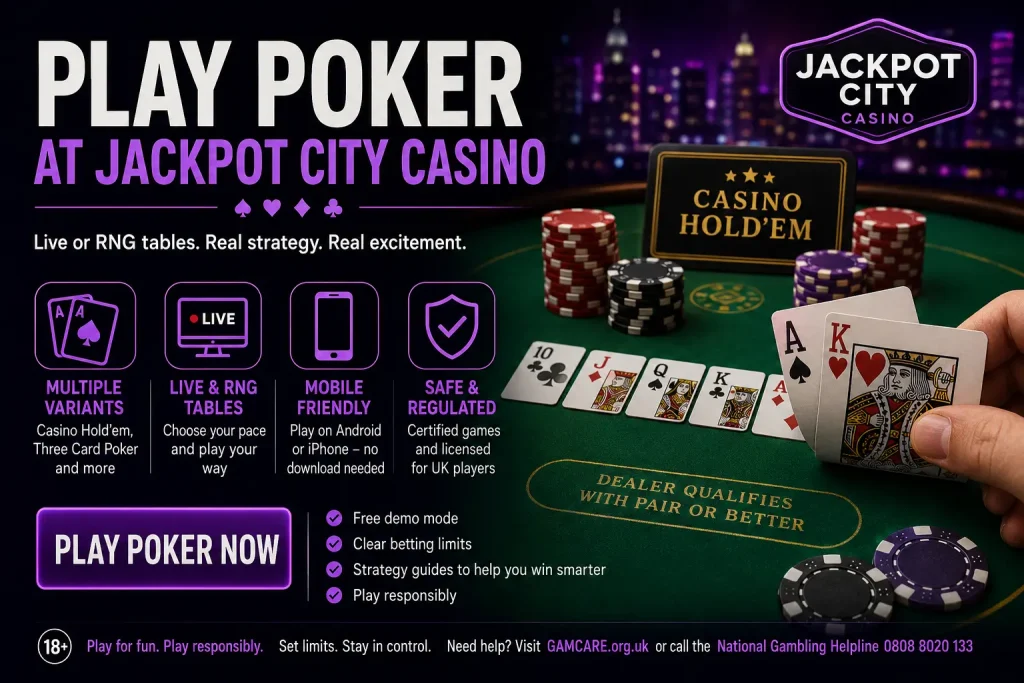
Why This Format Suits Online Casinos
Player-versus-dealer poker resolves each round independently, without waiting on other players to act. This makes it far easier to offer both fast RNG tables and steady live-dealer tables, since the game doesn’t depend on filling seats with real opponents the way traditional tournament poker does.
Step-by-Step: Playing a Hand of Poker
The exact sequence varies slightly by variant, but the general flow of a casino poker hand follows a consistent pattern that’s worth memorising before playing with real funds.
- Place your ante wager to begin the hand.
- View your hole cards once dealt.
- Assess your hand strength against the paytable or against any exposed dealer card.
- Choose to raise, call or fold based on that assessment.
- Allow any community cards to be revealed, if the variant includes them.
- Make further betting decisions as the hand develops.
- Compare hands at showdown using standard poker rankings.
- Collect any payout owed based on the outcome and side bets placed.
Once this rhythm becomes familiar, rounds move quickly, particularly in RNG formats where each stage resolves within seconds. Live tables follow the same sequence but at a more measured pace dictated by the dealer.
Understanding the Rules
Hand rankings sit at the centre of every poker rule set. From strongest to weakest, the order runs: Royal Flush, Straight Flush, Four of a Kind, Full House, Flush, Straight, Three of a Kind, Two Pair, One Pair, and High Card. This hierarchy applies consistently regardless of which specific casino poker variant is being played.
Betting structure is the second pillar. Casino poker games usually tie wager sizes to specific stages of the hand — an ante placed blind, followed by a raise decision once cards are visible, and in some variants a further raise once community cards appear. Maximum raise sizes are typically expressed as a multiple of the original ante, which keeps the structure predictable.
Dealer qualification rules also matter in several variants. Many casino poker games require the dealer’s hand to meet a minimum strength threshold to “qualify” for the raise portion of the bet. When the dealer fails to qualify, ante wagers are commonly settled automatically at even money, regardless of how the raise portion would have resolved.
| Rule Component | What It Means |
|---|---|
| Hand Hierarchy | Royal Flush is highest, High Card is lowest |
| Ante Bet | Required stake placed before cards are revealed |
| Dealer Qualifier | Minimum hand strength needed for dealer to compete on the raise |
| Raise Multiplier | Maximum raise expressed as a multiple of the ante |
Casino Poker Variants Worth Knowing
Poker isn’t a single fixed ruleset in a casino setting — it’s a family of related games, each with its own dealing pattern and betting rhythm. Getting familiar with the main variants helps in choosing the one that best matches a given player’s pace and risk appetite.
Casino Hold’em takes the community-card structure of Texas Hold’em and reshapes it into a player-versus-dealer format, with shared cards revealed progressively across the hand.
Three Card Poker is a faster, simplified format built around three-card hands, often paired with an optional Pair Plus side bet that pays independently of how the dealer’s hand performs.
Caribbean Stud Poker deals a full five-card hand to both player and dealer, with the player deciding whether to raise or fold after seeing a single exposed dealer card, frequently accompanied by a progressive jackpot side wager.
Ultimate Texas Hold’em shares its structure with Casino Hold’em but allows earlier and larger raises relative to the ante, giving players more room to apply strategic weighting to strong starting hands.
Card Mechanics and Table Setup
Every poker variant runs on a standard 52-card deck, shuffled by a certified random number generator in RNG formats or physically by a professional dealer during live sessions. Hole cards remain hidden to the player alone, while community cards — where the variant includes them — are placed face up for all participants to see.
The pacing of card reveals shapes the entire betting rhythm of a hand. In community-card variants, cards typically arrive in stages resembling the flop, turn and river structure familiar from traditional Hold’em, though condensed into fewer decision points to suit a casino table format.
Player Actions and Betting Options
Every hand of casino poker is shaped by a defined set of actions available to the player. Recognising these early on makes the transition from demo mode to real-money play far smoother.
- Ante: The opening mandatory wager placed before any cards are revealed.
- Call: Matching a required bet to remain active in the hand.
- Raise: Increasing the wager after assessing hand strength.
- Fold: Withdrawing from the hand and forfeiting the ante already placed.
- Check: Passing the action without additional wagering when permitted.
- Pair Plus / Side Bet: An optional wager resolved independently of the dealer comparison.
- Blind Bet: A secondary mandatory stake used in community-card variants.
- Showdown: The final comparison of hands once betting concludes.
Not every action applies to every variant. Three Card Poker, for instance, has a simpler action set than Ultimate Texas Hold’em, which introduces additional raise points tied to the community-card reveals.
| Player Action | Description | Likely Outcome |
|---|---|---|
| Ante | Placed before cards are dealt | Required stake to see your hand |
| Raise | Placed after reviewing hand strength | Boosts potential payout if the hand wins |
| Fold | Chosen with weak or unplayable hands | Ante is forfeited, further loss avoided |
| Side Bet | Optional, placed before the hand starts | Pays independently of the dealer’s hand |
Betting Limits at the Table
Ante minimums are generally set low enough to accommodate casual, low-stakes sessions, while higher-limit tables cater to players wagering more substantially per hand. Because exact minimums and maximums vary between poker variants and can be adjusted by the operator, it’s worth confirming current limits directly on the table interface before placing a wager.
RTP and House Edge in Poker
Return to Player in casino poker formats is generally fixed by the game provider and reflects the theoretical percentage returned to players over a large sample of hands when correct strategy is applied consistently. Variants like Casino Hold’em and Three Card Poker commonly sit in the mid-to-high 90s under optimal play, though the precise figure depends on the specific studio and ruleset.
House edge works as the inverse measure, representing the built-in advantage retained by the casino. Playing according to a published strategy chart keeps this edge as low as the game’s design allows, while deviating from that strategy — calling with hands that mathematically favour folding, for instance — increases the effective edge considerably.
Side bets typically carry a higher house edge than the main hand wager. Progressive jackpot options in particular are included for their large potential payout rather than favourable long-term odds, and should be treated as a separate, higher-variance decision from the core game.
Live Dealer Poker
Live poker streams directly from a professional studio, with a real dealer managing the shuffle, deal and payout process in real time. For players who enjoy the atmosphere of a physical card room, this format bridges much of the gap between online convenience and traditional casino floor play.
The pacing on live tables tends to be steadier than RNG versions, giving players more time to weigh each decision. Interactive chat with the dealer and visible card handling add a layer of engagement that draws many experienced players back to live tables once they’ve grown comfortable with the rules.
RNG Online Poker
RNG-based poker uses certified random number generation to shuffle and deal virtual cards, resolving rounds in a matter of seconds. This format suits players who prefer quick, self-paced sessions without the wait times tied to a live studio schedule.
Because RNG poker doesn’t rely on studio availability, it’s accessible around the clock, making it a practical option for sessions outside typical live-table hours. Fairness is maintained through independent testing and certification of the random number generator behind each variant.
Mobile Poker on Android and iPhone
Poker at Jackpot City Casino is built to run smoothly across Android and iPhone devices, either through a dedicated app or directly via a mobile browser. Demo versions of most variants can be tried without registration, giving new players a straightforward, risk-free way to learn the rules before committing any funds.
Betting controls are laid out clearly for touchscreen use, and card visuals scale appropriately without losing readability on smaller displays. Players who move between desktop and mobile sessions will typically find their account settings and history carry across devices seamlessly.
Demo Mode Versus Real Money Play
Demo mode gives full access to a variant’s rules, betting structure and pacing without financial risk attached, making it a genuinely useful tool for learning hand rankings and betting decisions before wagering real funds, particularly for less familiar variants like Ultimate Texas Hold’em.
Real money play introduces a psychological weight that demo mode can’t fully replicate. Betting decisions feel noticeably different once actual funds are on the line, which is why spending meaningful time in demo mode first is a habit worth building before transitioning to wagering with a real balance.

Beginner Strategy Notes
Strategy in casino poker variants largely comes down to disciplined hand selection rather than instinct. For formats like Casino Hold’em or Ultimate Texas Hold’em, published optimal strategy charts outline exactly which starting hands justify a raise and which should be folded, based on mathematical expectation rather than gut feeling.
A common beginner mistake is raising or calling out of impatience with borderline hands. Following a known strategy chart closely for the specific variant being played is one of the more reliable ways to keep the house edge as low as the game’s design permits — though no approach guarantees the outcome of any individual hand, since short-term card distribution remains unpredictable by nature.
Learning a variant’s qualification rules is equally worthwhile, since these directly affect how often ante bets resolve independently of the raise decision and should factor into how aggressively a player raises on marginal hands.
Managing Your Bankroll
Deciding on a fixed session bankroll before sitting down at any poker table is one of the simplest habits separating sustainable play from erratic play. Treating that figure as a hard limit, regardless of how a session unfolds, keeps decision-making grounded rather than emotional.
Bet sizing relative to bankroll matters just as much. Wagering a modest percentage of the total session bankroll per hand allows natural variance to play out without risking the entire balance during a short losing stretch. Tracking results across multiple sessions, rather than reacting to individual hands, gives a clearer and calmer picture of long-term performance.
Weighing the Pros and Cons
Poker, like every casino game, comes with a mix of strengths and trade-offs worth considering before adopting it as a regular game of choice. The table below summarises the points UK players most commonly raise when comparing poker against other casino card games.
| Strengths | Trade-offs |
|---|---|
| Strategic decisions directly affect outcomes | Steeper learning curve than simpler card games |
| Multiple variants suit different playing paces | Side bets often carry a notably higher house edge |
| Available in both live and RNG formats | Strategy charts require some memorisation |
| Demo mode allows genuinely risk-free practice | Live tables move slower than RNG versions |
Exploring Other Casino Card Games
Players who enjoy poker’s strategic pacing often gravitate toward other card-based casino games with similar mechanics. Blackjack shares the appeal of hand-value calculation and well-documented optimal strategy, while baccarat offers a faster, more streamlined comparison format for those who prefer simpler decision-making.
The full casino games library at Jackpot City Casino brings together the complete range of card, table and live-dealer titles in one place, making it easy to explore related variants without leaving the site.
Playing Responsibly
Poker is best approached as entertainment rather than a dependable source of income. Setting deposit limits, session reminders and loss thresholds before playing helps keep the experience enjoyable and within personal comfort levels. Account tools for setting these boundaries are available directly within account settings, and UK players can also reach independent support through organisations such as GamCare or the National Gambling Helpline whenever needed.
Spotting the early signs of problematic play — chasing losses, extending sessions beyond a planned budget, or playing longer than intended — becomes far easier when a bankroll and time limit have been agreed in advance. Regular breaks and a willingness to step away when a session isn’t going to plan are simple habits that protect both bankroll and mindset over time.
For a broader look at the platform, its licensing and its full range of games, UK players can visit Jackpot City Casino directly, where account tools and responsible gambling resources are laid out clearly.
Frequently Asked Questions
Is poker at Jackpot City Casino properly regulated and fair?
Yes, RNG poker tables run on certified random number generators independently tested for fairness, while live poker tables are streamed from licensed studios where a real dealer manages the shuffle and deal under supervised conditions, giving UK players confidence in every round.
Can I try poker for free before wagering real money?
Most poker variants at Jackpot City Casino include a demo mode accessible directly through the browser without any registration, letting new players practise hand rankings and betting decisions thoroughly before ever placing a real-money wager.
What’s the practical difference between live and RNG poker tables?
Live poker is streamed from a studio with a human dealer handling the shuffle and deal in real time, offering a slower, more social pace, whereas RNG poker resolves each round within seconds using certified software, suiting players who prefer faster, independent sessions.
Do I need to download anything to play poker on my phone?
No download is required for most poker variants, since they run directly through a mobile browser on both Android and iPhone devices, with demo access available before registration and full functionality once logged into a real-money account.
Does following optimal strategy guarantee winning at poker?
No, optimal strategy charts reduce the house edge over a large number of hands but cannot guarantee the outcome of any single hand, since card distribution remains inherently random regardless of how disciplined the strategy applied is.